How to budget for Christmas (7 steps, with a worked example)
Budgeting for Christmas is less about cutting back and more about deciding in advance. When you choose the numbers in November, December stops being a series of small surprises. Here is a simple method that works whether your holiday is modest or large.
Step 1: Decide where the money comes from
Before any list, work out what you can spend without borrowing: savings set aside for the holidays plus the part of November and December income that is not needed for rent, bills and normal living costs. That sum is your ceiling. If it is lower than you hoped, it is far better to know now.
Step 2: Set one total
Pick a single number at or below that ceiling. One total is easier to stick to than a dozen loose intentions.
Step 3: Split the total into categories
Gifts are the obvious category, but they are rarely the only big one. Typical categories: gifts, food and drinks, travel, decorations, wrapping and cards, events and outings, clothes, charity, and a buffer.
Step 4: Plan gifts per person
List every recipient and give each one an amount. Add the amounts up. If they exceed the gift category, adjust now: lower some amounts, suggest a Secret Santa, or move money from another category on purpose.
Step 5: Keep a buffer
Something always comes up: an extra guest, a forgotten teacher gift, higher food prices. A buffer of around 5–10 % of the total means those surprises do not break the plan.
Step 6: Track every purchase
Log each purchase on the day, against its category or recipient. This is the step most people skip, and the one that makes the difference. A holiday spending tracker on your phone makes it quick.
Step 7: Review in January
Compare planned with actual. Where did you overspend? Where was the estimate too high? Write a note for next year, and consider setting aside a small monthly amount from January so next Christmas is pre-funded.
Worked example
This is an illustrative example, not a recommendation. Say Anna decides she can spend €800 on Christmas without touching credit.
| Category | Planned |
|---|---|
| Gifts | €400 |
| Food & drinks | €180 |
| Travel | €90 |
| Decorations | €30 |
| Wrapping & cards | €20 |
| Events & outings | €30 |
| Buffer | €50 |
| Total | €800 |
For gifts she lists 12 people: partner €80, two kids €60 each, parents €40 each, two siblings €25 each, four friends €15 each, and a €10 work Secret Santa. That comes to €400 exactly, so the plan holds. In mid-December she has spent €70 on the partner's gift (€10 under) but food is running €25 over because of an extra guest. She covers it from the buffer and still has €25 left for surprises. In January she sees that food was underestimated and notes to plan €210 next year.
The arithmetic is simple. The hard part is keeping it up to date, which is why a spreadsheet that does the totals helps.
Christmas Budget & Gift Tracker — €4
Excel + Google Sheets. One-time purchase, instant download.
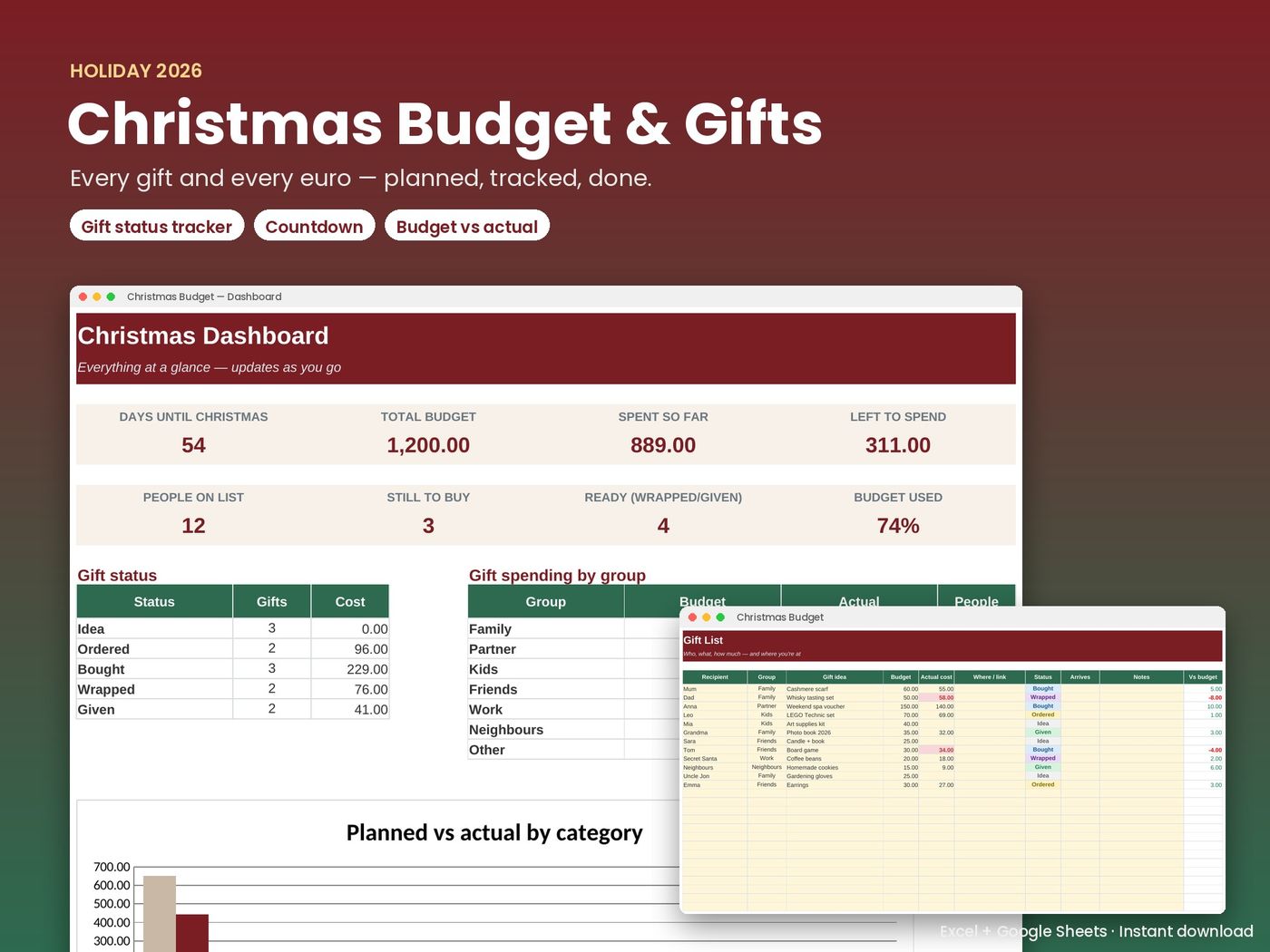
Buy now — €4 See what's insideThe Christmas Budget & Gift Tracker follows exactly this method: one total budget split into 9 categories, a gift list for up to 100 people, over-budget warnings and a dashboard with what is left. Read more in our Christmas budget spreadsheet and gift list template guides.
Frequently asked questions
How much should I spend on Christmas?
There is no right number. Base it on what you can pay from savings and spare income without borrowing, then set one total and stick to it.
When should I start budgeting for Christmas?
As early as possible. November is a good time to set the plan; starting a small monthly saving in January makes the next Christmas easier.
What categories should a Christmas budget include?
Gifts, food and drinks, travel, decorations, wrapping and cards, events, and a buffer are the most common. Add clothes or charity if they apply to you.
What if I go over budget in one category?
Cover it from the buffer or move money from another category on purpose, and write down why, so next year’s plan is more realistic.